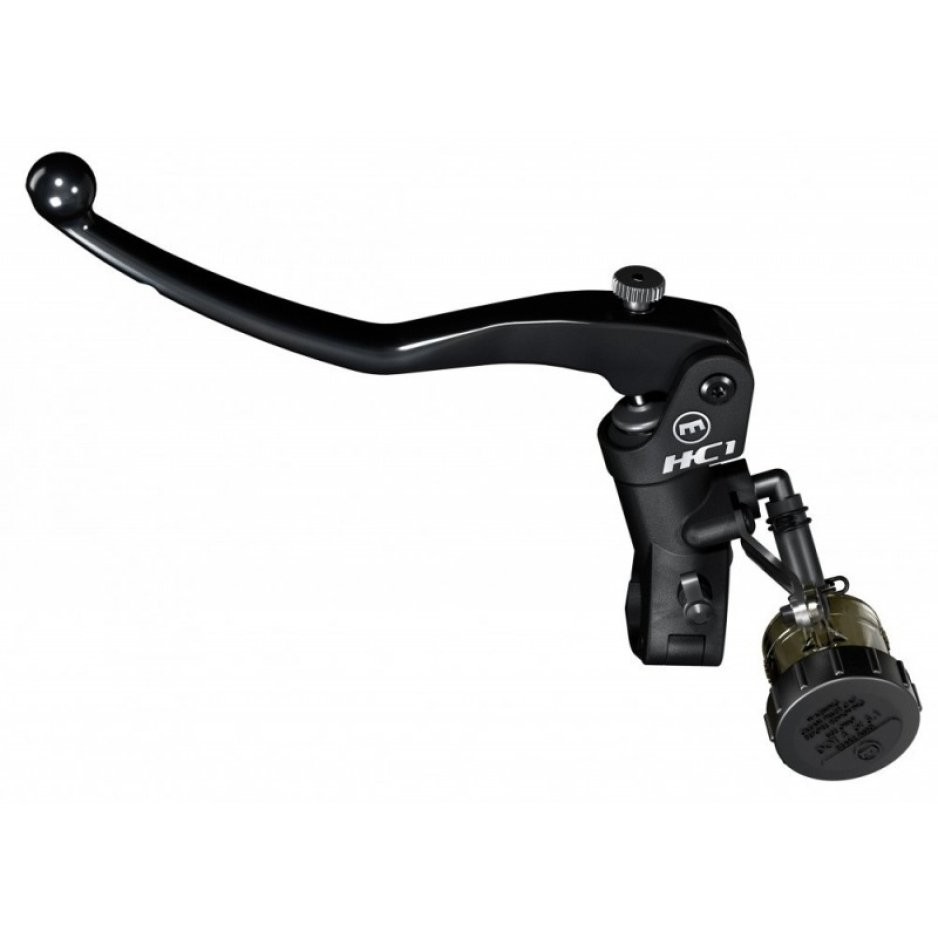
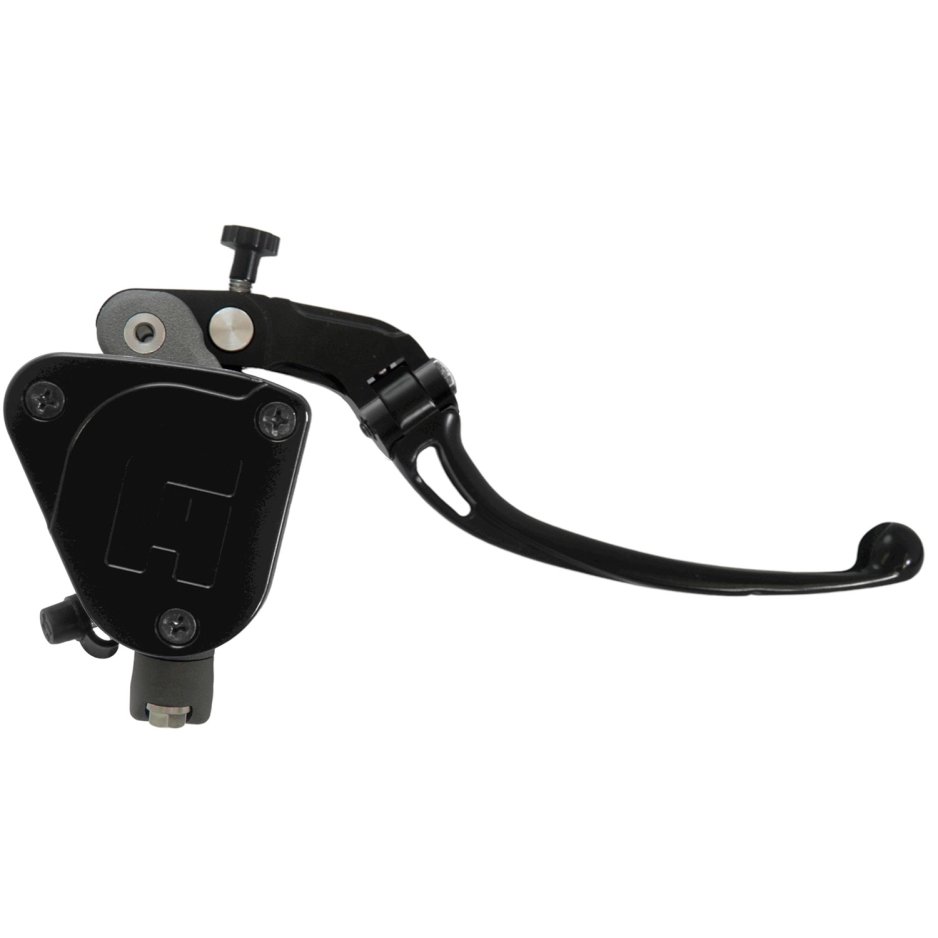
Brake Master Cylinder
Before choosing a brake master cylinder for the front brakes or a handbrake, you need to know and understand the characteristics that determine how it and the whole system work. Below is a description of the main characteristics with examples, and a method for comparing and choosing master cylinders.
Piston diameter
However many times smaller the master cylinder area is than the slave cylinder area, that's how many times the force applied to the master cylinder is multiplied at the slave cylinder. The larger the master cylinder area, the greater the force on the pushrod needs to be to brake the same slave cylinder.
In practice, fitting a master cylinder with a larger piston diameter will require pressing the brake lever harder to achieve the same braking as with a smaller-diameter master cylinder. Fitting a smaller-diameter master cylinder will require less force on the lever.
Why do top brake systems have large 19 mm master cylinders rather than small ones that would require less effort from the rider? Because top brake systems come with calipers with large slave cylinders that press the pads against the disc more effectively. Bigger slave cylinders mean a larger volume of fluid that the master cylinder has to push. If you fit a small-diameter master cylinder, the brake lever will hit the grip before the caliper pads close.
When determining the piston diameter, pay attention to the master cylinder design. The diameter is marked on all master cylinders, but there are reverse-stroke master cylinders, for example the ABM brake master cylinder. In such a master cylinder the piston moves upward, and the pushrod is inside the cylinder. So the pushrod area is non-working, which means it must be subtracted from the piston area. That's why the manufacturer states that an 18 mm piston diameter corresponds to 16.3 mm on a standard master cylinder. That is, their 18 mm master cylinder works like a regular 16.3 mm one.
Lever ratio
The force with which you press the lever is transmitted to the pushrod through the lever arm (the distance between the lever pivot and the point where the cylinder pushrod acts). For example, Accossato and Brembo mark the arm length on their master cylinders as the second number: 16×18 (16 mm is the piston diameter and 18 mm the arm length). On others you have to measure it yourself, and sometimes this is impossible without disassembly. Arm length affects how a brake master cylinder works in the same way as in a clutch master cylinder.
A shorter arm means you press the lever more lightly, but the lever travel increases, and vice versa. That's why master cylinders from different brands with the same piston diameter feel different when braking. For example, the Brake Master Cylinder Right 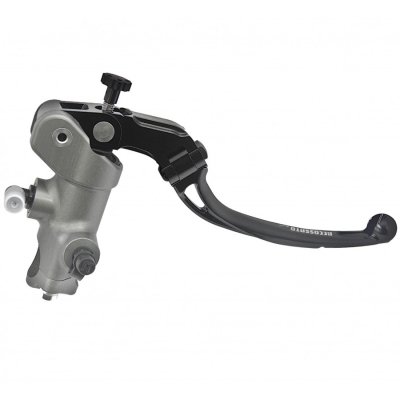 RUB 40,300 16×18 has an 18 mm arm, while the Magura 195 16 mm has a 21 mm arm. The Magura feels «harder», although the cylinder diameters are the same. There are advanced master cylinders on which the arm length is adjustable within a few millimeters (for example, the Magura HC3 or Accossato PRS). This adjustment lets a 16 mm master cylinder feel like a 15 mm or 17 mm one.
Type of master cylinder
Radial: the cylinder is perpendicular to the grip, and the lever arm is parallel.
Axial: the cylinder is parallel to the grip, and the lever arm is perpendicular.
There is no fundamental difference between these designs in terms of pressure on the slave cylinder. A radial master cylinder is more compact and lighter, and its design makes it easier to implement a short arm and its adjustment on a simpler, more compact lever. A radial master cylinder can have a larger-diameter cylinder without a significant increase in weight and size, since the base of the cylinder body becomes the handlebar clamp, while on an axial master cylinder it is a separate part of the body. So radial master cylinders have a larger cylinder diameter and a shorter arm (usually about 19 mm), while axial ones have a smaller cylinder diameter and a longer arm (usually about 25 mm).
Thanks to the compact, light body and the possibility of a larger piston diameter, radial master cylinders are used in racing. The lighter the better, and a larger cylinder volume allows slave cylinders of larger area for bigger pads; plus it means a larger volume of fluid, which takes more energy to heat up.
Comparing master cylinders
To determine how many times the overall ratio (the ratio of master and slave cylinder areas, taking arm lengths into account) of one master cylinder is greater than another's, multiply the ratio of the master cylinder areas by the ratio of their lever arms.
For example, the Revolution Brake Master Cylinder Right 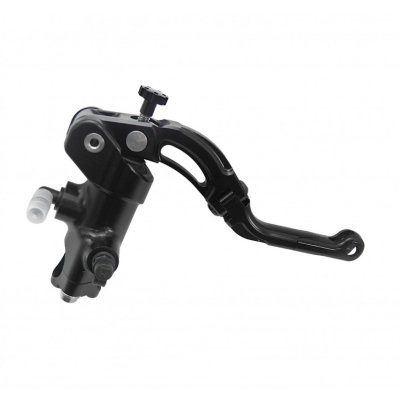 RUB 40,300 19×18 requires only 23% more effort from the rider to provide the same braking as a Nissin 14 mm axial master cylinder with a 27 mm arm, although the Accossato cylinder area is 85% larger than the Nissin's. This way you can compare, for example, the Brembo 16×18 and the Magura 195 16 mm (21 mm arm). The Magura requires 17% more force on the lever to provide the same braking as the Brembo. So if you replace a Brembo 16×18 with a Magura 195 16 mm, the brake lever will feel harder to the rider, and the caliper response sharper and faster because of the shorter lever travel.
Choosing a master cylinder
The choice of brake master cylinder depends on individual preferences and riding conditions: city, track, stunts, off-road. When replacing a stock master cylinder, you need to know its parameters and start from them, assessing how the overall ratio will change with a different one. It's very important to compare the overall ratio, taking arm length into account. It's much harder to choose a master cylinder for a system with arbitrary slave cylinders. For example, if you need to choose a radial master cylinder for a handbrake with two calipers and a 300–310 mm disc. First you need to calculate the total area of all the brake cylinders in these calipers. Their diameter is easy to measure with a caliper gauge.

Next, calculate the stock ratio of master to slave cylinder area for a motorcycle with a similar brake system. For this example it will be any sport bike with dual-disc radial brakes. For example, the slave-to-master area ratio on the 2008 Yamaha R6 and 2008 Honda CBR600RR is practically the same, about 12.8:1, although different master cylinders and calipers are used, with the same discs. From this you can conclude that for a radial system with two calipers, the optimal area ratio is about 12.8.
(R6 2008: 16 mm master cylinder, each caliper with two 30.2 mm and two 27 mm pistons; CBR600RR: 17.46 mm master cylinder, each caliper with two 32 mm and two 30.3 mm pistons)
If you divide the total area of the cylinders in the calipers you are choosing a master cylinder for by 12.8, you get the cylinder area of a radial master cylinder that will work well with these calipers. Finding its diameter from the area is no problem!
If you plan to use an axial master cylinder, multiply the resulting master cylinder area by the radial arm length (usually 18 to 21 mm; 19 mm on the R6) and divide by the axial master cylinder's arm length (usually about 25 mm; 27 mm on the Nissin 14 mm) to get the area of an axial master cylinder that will work well.
Once you know the required diameter of a master cylinder that will work like stock with these calipers, you can choose one with a lower or higher ratio to tune the brake to your preference.
You can get advice and buy master cylinders from the world's leading brands in our motorcycle shop. We work with Accossato, Magura, Nissin, Brembo, ABM, Spiegler, Motomaster, Braking and other manufacturers.