


Burnout: Technique Theory
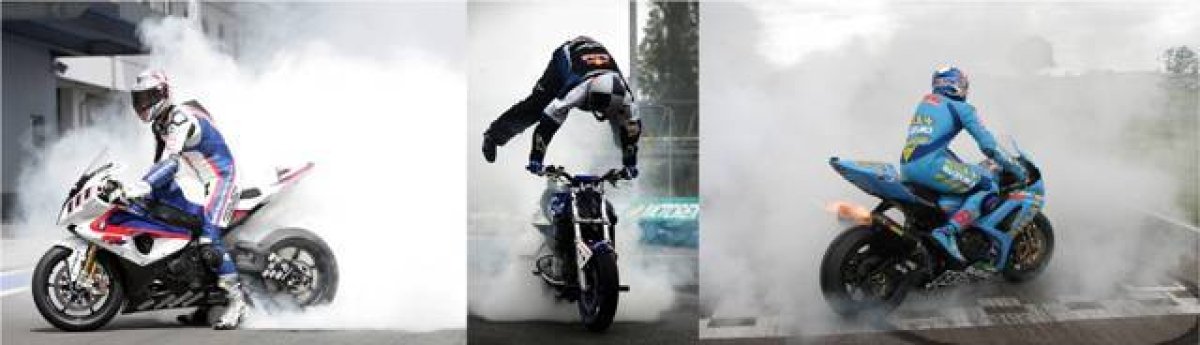
The urge to kill a tire is just as strong among owners of ordinary street bikes, not to mention streetfighters. Sometimes even chopper fans are guilty of it. For those who aren't in the know: a burnout is not some veiled way for the author to swear at an uninitiated audience, it is simply the term for smoking the rear tire.
There are four kinds of burnout, at least four main ones, but it's impossible to count all the variations. After all, you can do a burnout standing right in front of the motorcycle or deliberately laying it on its side. There are dozens more options, pure stunt rider moves like, say, a burnout combined with a wheelie or with a half-naked girl on the tank... But that's a very advanced level, and we are interested in the basics, so I'll start in order.
The simplest and easiest burnout is just killing the tire while standing in one place. The technique is quite simple, at least in theory. You squeeze the front brake and add throttle at the same time. Oh yes, I almost forgot: it would also be good to select first gear and release the clutch... That's exactly where the main difficulty lies. Squeezing the front brake isn't a big deal; even a well-fed scooter rider I know can manage it (he seems never to let go of it at all). But not everyone has the nerve to really twist the throttle and pop the clutch lever at the same time. Of course: deep inside lives a perfectly justified fear: what if the motorcycle actually moves?
As a result, the clutch isn't released fully but held half-engaged. I'll say right away: don't do this, it's a direct way to kill the clutch plates, and much faster than you can imagine! To protect yourself from destroying the plates as much as possible at the start, I would recommend bracing the front wheel against a high curb: this way you can minimize the load on the clutch and better feel the moment the rear wheel starts spinning without excessive extremes. After just two or three burnouts against a curb, you can start doing the same on a flat surface; I assure you, there's nothing difficult about it.
Much more spectacular (and harder) is spinning the rear tire while the motorcycle moves forward. To get into its technique, it's assumed that you have fully mastered the first kind of blowing burnt-rubber smoke in the audience's eyes. The main difficulty when burning the long-suffering rear tire on the move is breaking it loose. As a rule this is done in first gear, since that's where the engine has the most pulling power. But decent torque alone is usually not enough. You need to load the front wheel as much as possible, which reduces the pressure on the rear (that is, reduces the tire's grip on the surface), ultimately making it easier to break it loose.
In some ways this resembles what you do to lift the motorcycle into a wheelie, with the difference that the speed will be much lower (about 20 km/h). Rev the engine with the clutch half-engaged, shift as far forward as possible (don't be shy here, you can practically settle on the dashboard) and release the clutch sharply. If everything is done right, the rear wheel will definitely break loose. An important point: during all the above, your right hand lightly presses the front brake, but, I stress, only lightly, otherwise the motorcycle won't be able to move forward, and if you overdo the brake, you can lose the bike altogether. Your left hand should always stand by on the clutch lever as a backup, but only stand by, not hold the clutch half-engaged, thereby condemning it to an early death!
The less pressure you put on the front brake lever, the higher your speed, and vice versa. Much depends on the motorcycle, of course: the more powerful it is, the easier it is to keep a high speed while polishing the asphalt with the rear tire. If your machine has at least fifty horsepower, then once you've mastered this move in first gear, you can try second. The speed will be much higher there, and the visual effect much stronger! But the higher the speed, the harder it is to keep the rear wheel constantly spinning, and the price of a mistake is much higher than in relatively slow first gear. It should be noted that a rolling burnout can be done in two ways. The first is when the motorcycle is standing still, the rider breaks the rear wheel loose and then starts moving. The second is considered more spectacular and difficult (and not without reason): the burnout is done straight from riding. It looks many times more impressive but requires much more sophisticated technique and skills. It's one thing to break the wheel loose when stationary, and quite another to do it on the move...
Another way to blow smoke in the audience's eyes beautifully is to stand next to the motorcycle and «sentence» the rear tire. The technique is practically the same as the most primitive, «beginner» burnout, but with one small catch. Even a penguin can just stand next to a motorcycle, so we ease off the front brake a little, turn the handlebar a bit more and help the motorcycle a little by leaning it. As a result of all the above, the machine rotates around you with its rear tire smoking, while you, so handsome, draw the audience with your irresistible talent. In words it all sounds quite easy, but in practice it will take a lot of training to feel the slightest urge of your iron horse to get out of control and nip it in the bud. The best «whip» here is again the clutch lever, and you will also have to move your feet quite actively to keep up with the motorcycle...
Before I get to describing the hardest and undoubtedly the most beautiful, fourth kind of burnout, the so-called circular one, I want to dwell on the type of tire best suited for such exercises. The front tire type doesn't concern us at all, but the harder the rear tire, the longer you can keep polluting the environment with burnt rubber waste. So a touring rear tire is preferable. The worse its grip on the road, the better for burnouts! This is probably the only case where you want the lowest possible coefficient of grip between rubber and asphalt. So long live models like the Bridgestone BT 020, Metzeler Marathon, Metzeler Roadtec Z 6, Metzeler ME Z 4 (of course, this list is far from complete, but I think you get the idea)... All of them have proven themselves as excellent long-lasters, exactly what we need. I especially want to mention the Metzeler Roadtec Z 6, which managed to last about 14,000 km on my Suzuki TL 1000 R, setting a kind of longevity record on the rear wheel of a powerful sport bike with a not entirely sane owner. (Before that I considered the Bridgestone BT 020, which lasted 10,000 km on average, to be super resistant to asphalt abrasion.)
So, the motorcycle «writes» circles of the smallest possible radius while polishing the asphalt. Such a show leaves practically no one indifferent and immediately draws a huge crowd of onlookers. But before you try to master this sophisticated form of abusing machinery, I would recommend bringing your skills in the second burnout element to the point of automatism. In terms of technique, this element is rightly considered the hardest, since the motorcycle turns with quite a strong lean, but the speed when «drawing» circles on the asphalt is low, which means the centrifugal force acting on the motorcycle and keeping it from falling will «help» less than usual. All this requires a superb sense of balance from the rider, multiplied by a certain amount of recklessness (to be honest, I have never met anyone among maniacal burnout fans with even a spark of common sense in their crazy eyes...).
In principle, the basic elements of technique remain the same: the clutch is fully released, and the hand only «stands by» on its lever; the rotation speed is controlled with the throttle, the front brake and... lean! A circular burnout with a strong lean (a scary-sounding phrase, but it captures the essence precisely) is a sign of mastery, requiring filigree bike control and an excellent sense of balance. That the motorcycle will meet the asphalt more than once on the way to mastering it is not even a guess but a certainty. But the speed in such contacts is low, so the damage is mostly cosmetic. After all, if you are serious about this essentially pure stunt element, your motorcycle should be hung with sliders like a Christmas tree. It's also good to fit shortened clutch and front brake levers designed specifically for «light slides». I would also count rear-view mirrors and turn signals as completely unnecessary devices. Please note that the last remark applies solely to keeping the motorcycle intact in possible crashes, but works the opposite way on public roads.
The most experienced burnout artists, writing circles of the right shape with a decent lean and rotation speed, wrapped in clouds of smoke from their own rear tire dying for the sake of a beautiful show, even let go completely with their left hand! Thereby clearly proving that there's no need to «hang» on the clutch lever. Naturally, with this kind of «use», the tire's dirty underwear can show within literally minutes. The main thing here is not to miss... for the sake of censorship, let's just say not to miss the moment, since in the last moments of its short life on a stunt rider's motorcycle the rear tire usually explodes, overflowing with indignation and the feeling of having been cruelly set up. Right after this wonderful moment, if the «showman» isn't ready for it, a crash may follow...
In short, more persistence and practice, and everything will definitely work out; don't forget your riding gear, which will save you when you make a mistake. Just don't forget to include tire fitting services in your budget, along with clutch plates and a certain number of rear tires. What did you expect: a beautiful show has to be paid for.