Sprocket and Chain for a Stunt Bike
Chain
Chains come in different sizes and, accordingly, strengths: 520/525/530.
Obviously, the 520 is lighter, which improves the wheel's response to changes in engine drive thanks to its lower mass. But such a chain has a shorter service life: it stretches faster and starts to «eat» the sprocket, especially an aluminum one. A 530 will last much longer, but because of its mass, transmission losses increase and power at the wheel drops.
As a rule, 600 cc motorcycles use 520 and 525, and liter bikes use 530. Everyone fits a 520 chain to stunt bikes, since it is cheaper and a kit with such a chain is much lighter. Besides, 520 chains are now made that are as strong as 530s. It's best to buy top models with an anti-corrosion coating, for example the RK GB520GXW. Thanks to advanced seals, such chains need no maintenance.
Rear sprocket
Rear sprockets are steel, aluminum or hybrid. The advantages and disadvantages are obvious! Steel ones are durable but heavy. Aluminum ones are light but wear quickly. Hybrid ones (steel teeth, aluminum body) combine the advantages of steel and aluminum, but cost more, as they are more technologically advanced.
+ (0–5) — a great option for beginners who want to try stunt riding while still using the motorcycle on the road. Acceleration will increase and top speed will drop by 10%, which isn't critical.
+ (5–10) — gives a sharper lift and smoother drive at idle for slow wheelies, while still letting you ride around town. Top speed will drop by 20%.
+ (10–15) — steady, sufficient drive for technical and slow wheelies. You can still ride into town, of course, but for fun rather than transport. Fuel consumption increases noticeably and top speed drops by 30%. The choice of most stunt riders for training.
+ (15–20) — a very strong pull from the bottom, smooth and powerful low-end drive for difficult, technical tricks. No roads, only the lot and serious training. Minus 40% of top speed.
In professional stunt riding, riders compete on different sprockets, choosing a combination to suit their style and speed. On small sprockets the freestyle is fast and wide, but without slow technical tricks. On big sprockets the riding is more compact and slower, but harder.
The optimal combination
At first it is recommended to fit a medium-sized oversized rear sprocket, or even start with the stock set. You may be perfectly happy with the standard combination.
- Don't fit a big one right away: it will slow down learning, since the bike will be jerky and react too strongly to a small throttle opening.
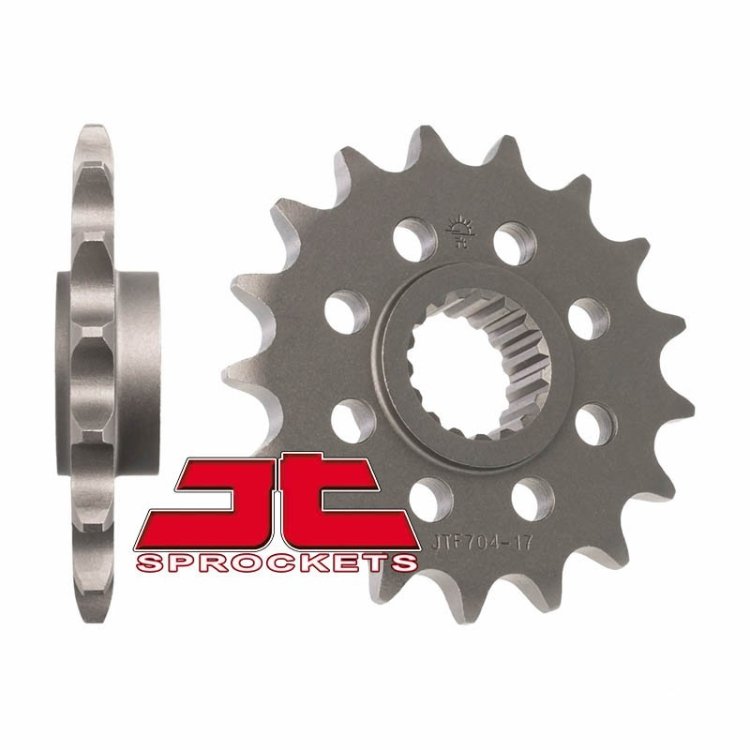
- 1 tooth on the front sprocket is equivalent to 3 teeth on the rear, that is, by reducing the front sprocket by one tooth you effectively increase the rear by 3, and vice versa.
- Increasing the rear sprocket by 2–3 teeth will require replacing or lengthening the chain.
So it is best to start with a medium-sized rear sprocket or stock. If you need a bigger sprocket over time, it will be enough to reduce the front one, which is much cheaper than buying a new rear sprocket and a chain for it.
As a rule, most pro riders ride in the range of +5 to +17 on the rear sprocket. The spread is very wide!
If something doesn't work at first, it's not the sprocket, it's skill! A sprocket can affect confidence and consistency, but not the ability to do a trick. Overall, the choice of sprocket (sprocket combination) is individual and depends on the rider's style and the tricks they prefer.
Personal experience and that of friends shows that it's better to learn on small rear sprockets (+5 at most), since with a big sprocket the motorcycle behaves very abruptly and it is hard for the rider to adapt.
The idea that a motorcycle lifts onto the rear wheel more easily with a big sprocket is a misconception! When lifting the motorcycle from a standstill or at low speed (which is the best way to start your first wheelie), the main thing is to distribute your body weight correctly and load the tail.