M-Unit Blue BMW K100RS Electrics
Our follower, who has a custom K100RS bike, asked us to install the M-Unit Blue control hub, replace the Chinese no-name optics and connect the Motoscope Pro gauge. The main problem was the barely noticeable turn and brake signals, as well as an incomplete and not fully functional dashboard. We’ve already done something similar on the BMW K1100LT, so we agreed to do that, especially since the K100 electrics are a little different, and this is the most popular donor for the cafe racer bikes thanks to a shortened base and a lighter swingarm relative to the K1100 models.
The M-Unit installation requires an expensive comprehensive upgrade, but as a result it provides minimalistic handlebar controls, wide functionality, simple and reliable electrics:
- Standard controls must be replaced with controls with push-buttons to operate a motorcycle. You can save the original controls with switches, but this will require relay converters, which take up space, increase the number of wires and are additional elements of the system.
- On the K100, brakes and clutches are integrated into the controls, so it’s necessary to install the new ones. The original remotes can easily be exchanged on the second-hand market for components from modern bikes.
- Optics and the dashboard in this case are completely replaced by new ones. The advantage of branded components is that they are certified, guaranteed to shine brightly and work reliably. There are inexpensive original models, so it’s not necessary to buy expensive Motogadget products.
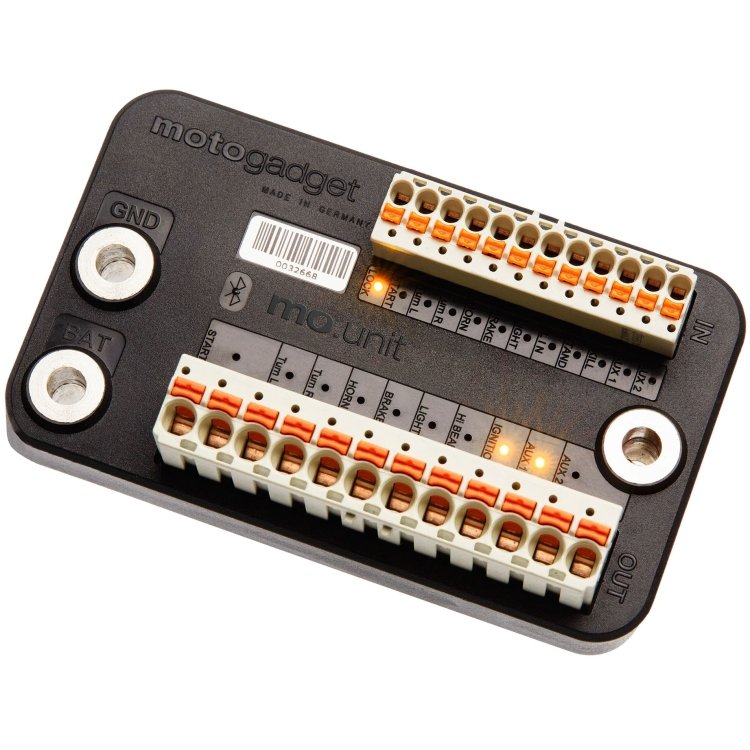
We installed the M-Unit Blue with a Bluetooth smartphone connection. In addition to keyless access and alarm, this controller modification has advanced functionality through the smartphone menu, which greatly simplifies the connection of the fuel pump and allows you to remove at least one relay in the circuit.

Below you can find the description on how to connect the elements and set up the functions:
Optics
Optics connection (headlight, turn signals, side lights, brake light) is shown in detail in different videos on our channel. It’s not complicated: consumer units are plugged into the corresponding output ports on the M-Unit, and switch buttons and brake sensors are plugged into the corresponding input ports on the M-Unit. We recommend using the M-Button relay, which combines all the wires from the remote controls into one — this greatly reduces the number of wires going to the M-Unit. Now let’s look at each element separately:
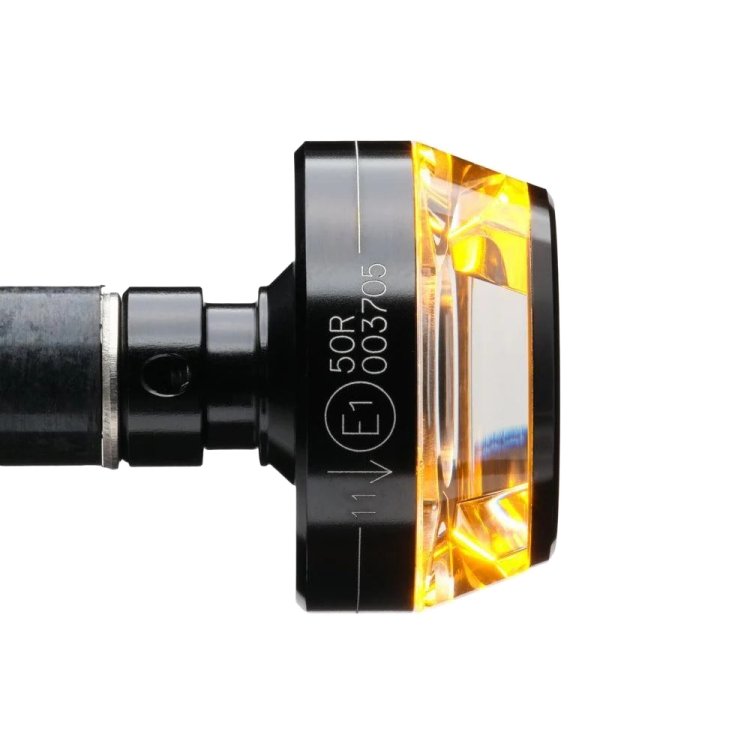
Motogadget M Blaze Disc Turn Signals. This is a great solution for a minimalist style. They replace the bar end weights, which should be on the motorcycle anyway, but they eliminate the turn signal brackets and the turn signals themselves. They shine very brightly both ways, which is much more noticeable on the road. They are equipped with thin, but very durable wires.
Kellermann Bullet 1000DF turn signals with brake and parking lights. This is an excellent solution when there is no stop signal or if you don’t want to install it at all which happened in our case. Turn signals are very bright and equipped with surge protection. It has an aluminum casing, the ground can be connected to the casing, for example, under the fastening nut. This very cool solution allows you to get rid of two wires in a braid. We ran these wires anyway, because the owner can cover the frame with powder coating, and there will be no contact between the turn signal and the frame. At the moment there is contact, since the frame is painted from a spray can and has cracked at the mounting spot. Under such a scheme, it is initially necessary to run a ground wire from the frame close to the turn signals or to expose the frame at the turn signal mounting spot to create the contact. The price of turn signals is fully justified, as it still allows you to save money on a stop signal and mount. It also reduces the braid of the rear optics wires. Thus, they’re reliable and very bright. So we definitely recommend them!
LSL Eighties headlight. This is a classic headlight with a short body, which fits well in almost all large Cafe Racers such as the K100. A small headlight is more suitable for Scramblers (it is better hidden in the motorcycle dimensions, it gets damaged less in case of a fall, the speed on the off-road is lower, the lighting may be worse), an elongated headlight is suitable for high-speed Cafe Racers (the length emphasizes the silhouette, the shape is more streamlined, which allows you to place an effective reflector for better lighting at high speeds). For a city bike with a long base, LSL Eighties is a good low-cost solution. The headlight is light, in an aluminum case, and there’s enough space to locate the connectors of the remote controls and M-Button relay inside.
Fuel pump
Usually the way the fuel pump operates is the following: it’s short prepumping when the ignition is turned on and constant pumping when the engine is running. To keep this behavior, we would need to save the original relay or even two (we decided to do it differently though).
We decided to not keep short prepumping when the ignition was turned on and connected the fuel pump to the AUX2 port, which we set to switch control. This can be done through the M-Unit settings on a smartphone. We used a yellow-brown control wire from the ignition unit as the switch, which closes on the mass during the engine is operating.
Thus, the fuel pump turns on when the starter button is pressed and continues to work until the engine stops. Prepumping when the ignition is turned on is not very important. Theoretically, without priming you need to crank the starter about a second longer, but in practice the engine starts just as quickly.
We think that the electrical circuit simplification is more important than a slight saving of the battery power.
Radiator Fan
The fan control relay on the K100RS is multifunctional. It not only turns on the fan, but also activates the overheat indicator on the dashboard. We decided to leave it, despite its size. Replacing it with a more compact one, as well as replacing the original temperature sensor with a Motogadget sensor, is expensive, but doesn’t change much.
Motoscope Pro Dashboard
Motoscope Pro dashboard requires the installation of a Breakout Box converter, which connects all sensors except the speed sensor (which goes directly to the dashboard).
- Low fuel indication. The original fuel level sensor works well with Motoscope Pro. It is enough to connect the yellow wire to the Breakout Box and calibrate the dashboard.
- Oil pressure. The original sensor plugs into the Breakout Box OILSW port.
- Neutral. The K100 has the same gear counter as the K1100. To get a neutral signal from it, we made a converter from two control relays connected in series. The converter must be powered up, and the output signal must be connected to the Breakout Box, to the corresponding NEUTRAL port.
- Overheat indication. The overheat signal exits the fan control relay. We combined this signal with the oil pressure signal to the OILSW port. When the ignition is turned on, a red indicator lights up to indicate insufficient oil pressure — after starting the engine, it disappears, as the oil pump raises the pressure. If the indicator lights up while riding in hot weather or during continuous operation at low speed, this will mean the engine overheating. We don’t think it’s a problem that the coolant overheating and oil pressure are displayed on the same indicator, since these signals have different switching mechanisms. So it’s easy to tell which one it is. By the way, this indicator signals a low battery charge with blinking as well.
- Turn signals and a high beam. To display these signals on the dashboard it is enough to connect the signal from the consumer units to the necessary breakout box ports.
- Tachometer. The standard tachometer signal is connected directly to the dashboard and is correctly displayed without additional settings.
- Speedometer. The speed sensor from the Motogadget kit is connected directly to the dashboard and is configured by setting the wheel diameter or teaching while riding.
Also installed on the motorcycle:
Adjustable clip-ons ABM MULTI CLIP-ONS — in our opinion, this is the best solution for a bike on clip-ons. You can adjust the handlebar as you like, they look great and allow you to hide wires in tubes. They are also durable and will survive more than one fall.
The ABM clutch lever and brake master cylinder are cool German components, the master cylinder has a unique mechanism of the floating lever arm, which shortens as you squeeze the lever and reduces the pull effort. It does not require bleeding and it’s equipped with an integrated reservoir. But the best thing about it is the design that perfectly suits the overall handlebar style. It’s expensive, though, and you can find other high-quality components for less money.
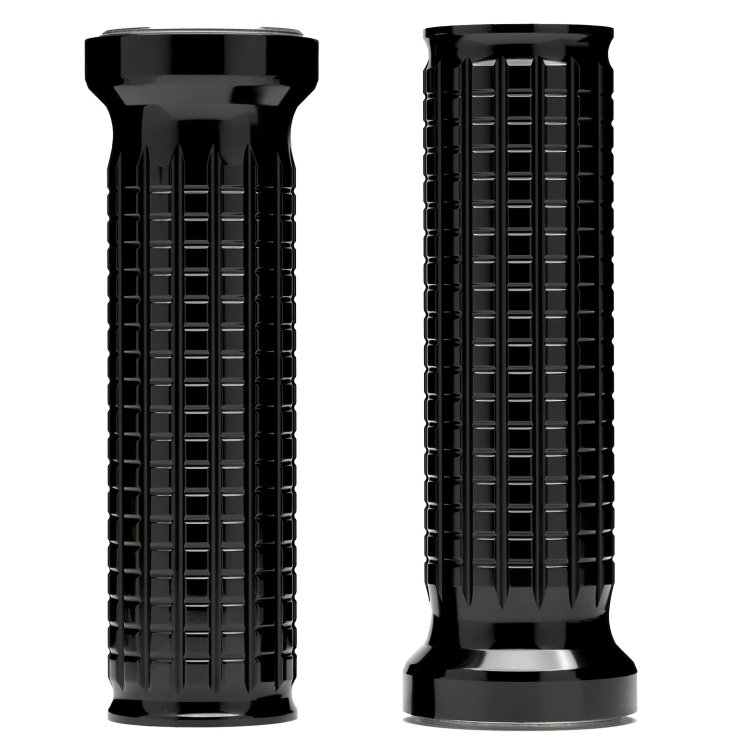
Motogadget M-Grips aluminum grips. So far, this is an unclear solution for us. They look very cool, and with gloves on they are very grippy. We don’t know yet how they feel on a long ride. We think that comfort depends on the gloves thickness as you may get calluses when wearing the thinner ones.
Motogadget M-switch remote controls. These are classic remotes, they can be found on every second project of ours. There’s a good balance between button accessibility and compactness. Of course, the smaller the better, but the smaller buttons would be uncomfortable to press. Two three-button remote controls are enough for the standard functionality of the motorcycle.
In conclusion, we’d like to thank the Germans for the cool M-Unit Blue controller. This compact unit makes controlling the electrical consumers on a bike or car easy and safe. It provides keyless access from the phone, it’s equipped with a tilt sensor and operates as alarm as well (the standard signal is used instead of a siren). The ability to monitor motorcycle data on the phone can be useful for professionals and non-professionals alike.
We'd like to make something with fully custom electrics based on the M-Unit, with the engine control unit and all sensors’ replacement, but unfortunately we don't have a bike which this work can be done with.